
First published in essentialARB, October 2026, as Part 1 of The Arb Business Series.
Over the last couple of years in this column we have worked our way through the Arb Approved Contractor Scheme, module by module, in bite-sized chunks. If you have followed it through, you should be in good shape for assessment. What we want to do now, in this new five-part series, is look at the wider business behind the contracting.
Compliance and winning work are not separate things. They are two sides of the same coin. The work you have put into your systems to satisfy an assessor is the same work that gives you the confidence — and the evidence — to demonstrate your competence to clients. Better systems lead directly to better contracts. Along the way in this series we will share the hints and tips that we have seen work for other contractors.
This first one is about winning and keeping the right work. Most of the contractors who first contact us are busy. A surprising number of them are not as profitable as they think they should be. The two facts are usually related.
Busy isn't the same as profitable
A common conversation in our office goes something like this. A contractor calls. They are working flat out. The diary is full into the autumn. Their team is good. The phone keeps ringing. So why are they on the phone to us, frustrated, with no money in the bank?
The answer is almost always the same. They have built an any-work pipeline. Every enquiry that comes in gets a quote. Every quote that gets accepted gets done. The work that comes in dictates the diary, the diary dictates the cash flow, and the cash flow never quite settles. We call this being a busy fool. It is the default condition of the industry, and it is the trap most contractors spend years in before they realise they are in it. Every "yes" to wrong work is a "no" to right work that turns up next week.
The first job, before anything else, is to know your numbers. What is your true profit margin, and on which work? Most contractors know their turnover. Very few know their margin, and even fewer know the margin on each part of the business. We have lost count of the number of contractors who, when they finally sit down and do the sums on the firewood and log delivery side of the business, find that they have been running it at a loss for years — propped up quietly by the tree work next to it. If you don't know what each part of the business is making, you don't know which part is actually feeding you.
Who exactly are you working for?
When we sit down with a new client, one of the first questions we ask is who their ideal customer is. We mean it in detail — where they live, what they read, what they drive, what they value, what they would expect when they answered the door to you. Different baits catch different fish. Until you know who you are fishing for, you will keep casting into the wrong water.
A contractor came to us a while back who was struggling to make ends meet. Their pricing was caught between the small new-entrant operators undercutting the domestic market and the properly geared-up contractors winning the commercial work. They were competing against neither — and being beaten by both. The bottom end was cheaper because they had no overhead to cover; the top end was outclassing them because they had invested in being properly set up. Stuck in between is no market at all.
The fix wasn't to compete harder on price. The fix was to pick a market and design themselves for it.
Get out of the price race
Most of the bottom end of the industry competes on price. The trouble with competing on price is that the only way to win is to be cheaper than the next person — and there is always someone cheaper. We always say: get out of the price race and into the professionalism race instead. The latter is far less crowded.
There is plenty of evidence that the better companies can charge more. We spoke to a contractor in January a few years back who told us he was already booked out to May, charging just over half the going domestic rate in his area. The fact that customers were prepared to wait five months tells you exactly what was going on — he was far too cheap. We suggested he add £100 a day to his rate and see what happened. Then another £100. He would know he had it about right when around 30% of his enquiries were politely going elsewhere. Every penny of the increase was pure profit.
The market you compete in is partly a choice. Facebook and the cheap end of the local-search world is one market; the ArbAC directory, your professional reputation and word-of-mouth between high-end clients is another. They behave differently and they pay differently. Pick which one you are aiming at and aim properly.
Image counts more than people realise
Once you've picked your market, everything about how you present has to match it. The van, the kit, the uniform, the way the phone gets picked up, the way your team introduces themselves on the drive, what your website looks like at 9pm on a Sunday when a potential customer is making a list. All of it is information to the customer about what kind of company they are about to hire.
We've always liked the line "never drive a better car than your customer," and there's truth in it. An enquiry from a hard-working family on a busy street will probably feel more comfortable with chainsaw trousers, a company t-shirt and a sensible van on the drive. An enquiry from the smarter end of town may prefer chinos, a shirt and a clean pickup. Neither is right or wrong — but a mismatch costs you the job before you have priced it.
The phone is the biggest one. If your phone rings out, goes to a voicemail nobody listens to, or gets answered with "yeah?", you have lost the customer before they have spoken. The contractors who win the better work answer the phone professionally, ask the right questions, and follow up the same day. None of this costs money. All of it costs attention.
Be the easy yes
When a customer — domestic or commercial — is choosing a contractor, what they are really deciding is who to trust. Business is all about trust. They want to know that hiring you won't turn into a problem: that you will turn up, do the work properly, look after their property, behave well around their family or their staff, and not leave them dealing with the fallout if something goes wrong. The more professional the customer, the more formal the way they go about establishing that trust. A domestic client might glance at your website and your reviews; a commercial client will send you a pre-qualification questionnaire and ask for documents.
Your job is to be the easy yes. Everything they might ask for should already be packaged and ready to go: insurances in date and in one PDF, your health and safety policy, your ArbAC certificate, RAMS that show how you actually work, terms and conditions that aren't pulled off the internet and maybe even some testimonials from happy customers. The contractor who is still searching the loft for their insurance certificate has already lost the job to the contractor whose pack went out before the procurement manager finished their coffee.
A useful indicator of where you sit on this scale: if you can produce a clean pre-qualification response within an afternoon, you are in good shape. If pre-qualification questionnaires fill you with dread, you are not yet competing in the market you should be aiming at. The next article in this series will go deeper into what a good pre-qualification submission looks like in practice.
Keep them once you've won them
The other half of the equation — the more profitable half — is keeping the customers you already have. The standard arb business model is to chase new enquiries while merrily waving goodbye to last year's customers. The contractors who are quietly doing very well are doing the opposite: they have set themselves up so that every job done becomes a future enquiry waiting to happen. Shake the tree the right way and repeat work falls out of it.
The mechanics are not complicated. Every enquiry, job or not, gets captured as a contact with name, address, number and a note of what they asked about. Every completed job gets a brief note in the same place: what you did, when it should next be looked at, anything you noticed about the rest of the garden. Then a reminder goes in the diary — eighteen months, two years, three years, whatever feels right for the work. When the reminder comes up, you pick up the phone. Most contractors don't do this not because it is difficult but because ringing a customer from two years ago takes a certain amount of bravery. The ones who do it are rarely short of work.
There are also passive ways to stay in front of previous customers — a regular blog on your website, the occasional social media post, a seasonal email — none of it pushy, just enough to keep your name in their head for when the time comes. Customer relationship management (CRM) systems can automate most of the follow-up activity for you, which sounds great until you realise that automation works on whatever data you put into it. Sending an "is it time for your annual prune?" message to a customer whose tree was removed last year is the sort of mistake the system will happily make on your behalf. Whatever system you use, keep the data clean and check who is actually being contacted before you press send.
A customer who already trusts you is worth a great deal more than a stranger who has just found you on a search engine.
The next four articles in the series will look at money, risk and resilience; people, culture and leadership; sales, marketing and professional image; and tendering for and winning the larger contracts.
Fred Burkitt is a Consultant at Elcoat/Burl Consulting. We help arboricultural contractors grow through systems, accreditation and business support. If this sounds like something you need, drop us a line on info@burlconsulting.com.
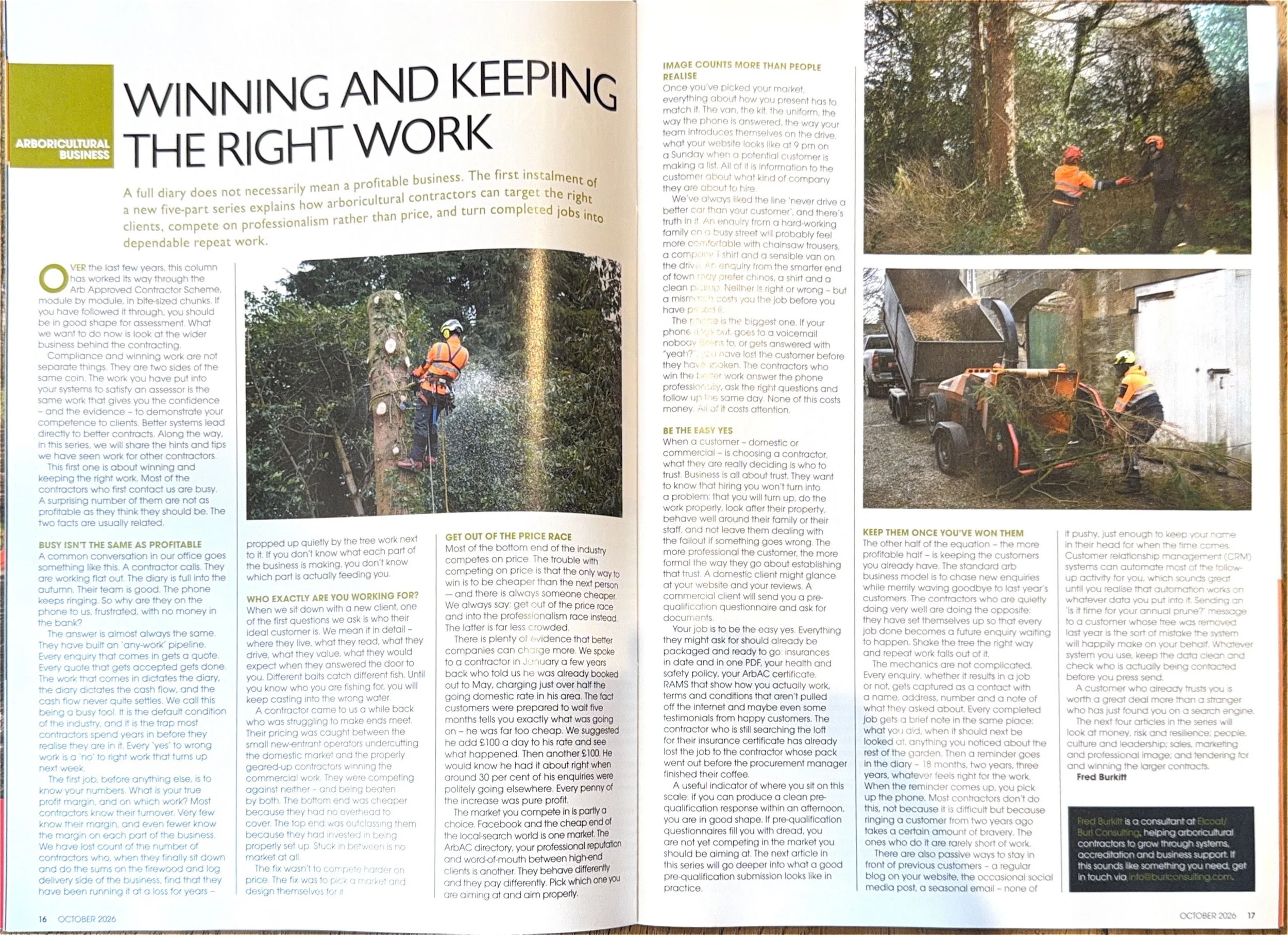
As published in essentialARB, October 2026 (pages 16-17).